Twelve kinds of taste
Which one are you?
Rate five things you know, from any shelf. Your archetype shows up in about a minute, and gets sharper with every log.
Rate five things you know, from any shelf. Your archetype shows up in about a minute, and gets sharper with every log.
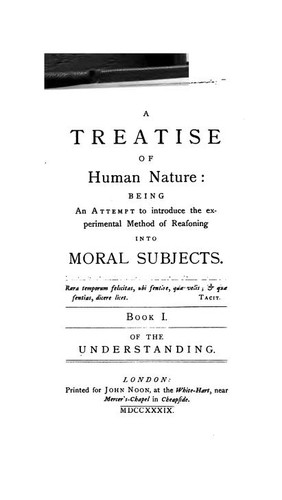
Philosophy, English Philosophy, Natural theology, Early works to 1900
The eighteenth-century Scottish philosopher's classic work on human understanding and morals.
Join free to log it and keep your ratings, or see your odds on it first.
No profiled raters yet.

No reviews yet. Yours would be the first word on it.
On Open Library, 6 have read it and 36 want to.
“ALL the perceptions of the human mind resolve themselves into two distinct kinds, which I shall call IMPRESSIONS and IDEAS.”
David Hume (7 May 1711 [26 April O.S.] – 25 August 1776) was a Scottish philosopher, historian, economist, and essayist, known especially for his philosophical empiricism and skepticism. He is regarded as one of the most important figures in the history of Western philosophy and the Scottish Enlightenment. Hume is often grouped with John Locke, George Berkeley, and a handful of others as a British Empiricist. Source: [English Wikipedia][1] [1]: http://en.wikipedia.org/wiki/David_Hume
Answer first; then see how everyone, and your circle, split.
“Is this David Hume's best work?”
Sign in to answer.
Be the first to answer.
“Is A treatise of human nature harder work than it needs to be?”
Sign in to answer.
Be the first to answer.
“Is A treatise of human nature a masterpiece, not merely a very good book?”
Sign in to answer.
Be the first to answer.