Twelve kinds of taste
Which one are you?
Rate five things you know, from any shelf. Your archetype shows up in about a minute, and gets sharper with every log.
Rate five things you know, from any shelf. Your archetype shows up in about a minute, and gets sharper with every log.
Translating and interpreting, Übersetzung, Prosodie, Lied
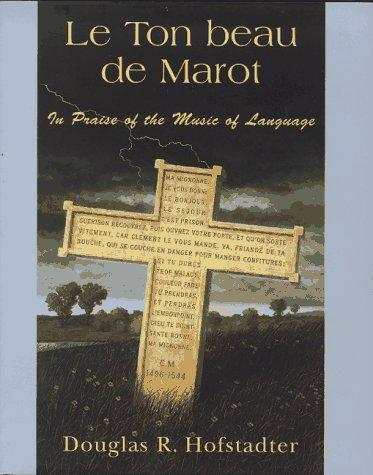
Not Merely a set of translations of one poem, Le Ton beau de Marot is an autobiographical essay, a love letter to the French language, a series of musings on life, loss, and death, a sweet bouquet of stirring poetry - but most of all, it celebrates the limitless creativity fired by a passion for the music of words.
Sign in to log this.
Character-led, spare, contemplative and prestige.
No profiled raters yet.

No reviews yet. Yours would be the first word on it.
On Open Library, 4 have read it and 18 want to.
“Precisely one-half a millenium ago - and I mean what I say when I say it's precise - on the twenty-third day of the next-to-last month of the year fourteen hundred fourscore-and-sixteen (a tip of my hat to the Gauls' counting scheme), in the humble French town of Cahors en Quercy, some sixty-odd miles to the north of Toulouse, was born a bright boy christened Clement Marot, the son of an auto-taught poet named Jean and a lady whose life's but a question mark: our focus thus shifts from his folks to their lad.”
Douglas Hofstadter is an American scholar of cognitive science, physics, and comparative literature whose research includes concepts such as the sense of self in relation to the external world, consciousness, analogy-making, artistic creation, literary translation, and discovery in mathematics and physics. His 1979 book *Gödel, Escher, Bach: An Eternal Golden Braid* won both the Pulitzer Prize for general nonfiction and a National Book Award for Science. His 2007 book *I Am a Strange Loop* won the *Los Angeles Times* Book Prize for Science and Technology.—*Wikipedia* 2021-03-03
Closest on the same fourteen dimensions, from everything scored on Taste Buds. Other media included when they land close.